Your first days as a manager
A practical starting point for newly promoted managers who need to establish control without trying to change everything at once.
The pressure to prove yourself can be strongest in the first few days. That often produces the wrong behaviour: too many promises, too many changes and too much time spent doing the work you were promoted from. A better start is to understand the operation, the people and the expectations before deciding what needs to change.
1. Clarify what you are accountable for
Start with outcomes. What numbers, standards, deadlines or service levels are you expected to deliver? Which decisions are yours, and which still need approval? Ask your own manager what a good first month would look like and where they most need you to create stability.
2. Learn before you fix
Spend time observing how work actually moves through the team. Ask where delays occur, what repeatedly causes frustration and what the team relies on to get through a normal day. Separate recurring patterns from one-off complaints. Your aim is understanding before intervention.
3. Establish a simple management rhythm
Decide how you will keep track of priorities, speak with team members and review performance. A small number of reliable routines is more useful than an ambitious system you cannot maintain.
4. Separate urgent from important
Not every inherited problem deserves immediate attention. Deal first with issues that affect safety, customers, delivery, quality or the team's ability to work. Record the rest and review them once you understand the operation better.
5. Stop measuring your value by how much work you personally complete
Your role has changed. You still need enough operational knowledge to understand the work, but your contribution increasingly comes from setting direction, removing obstacles, developing people and making sure the team delivers.
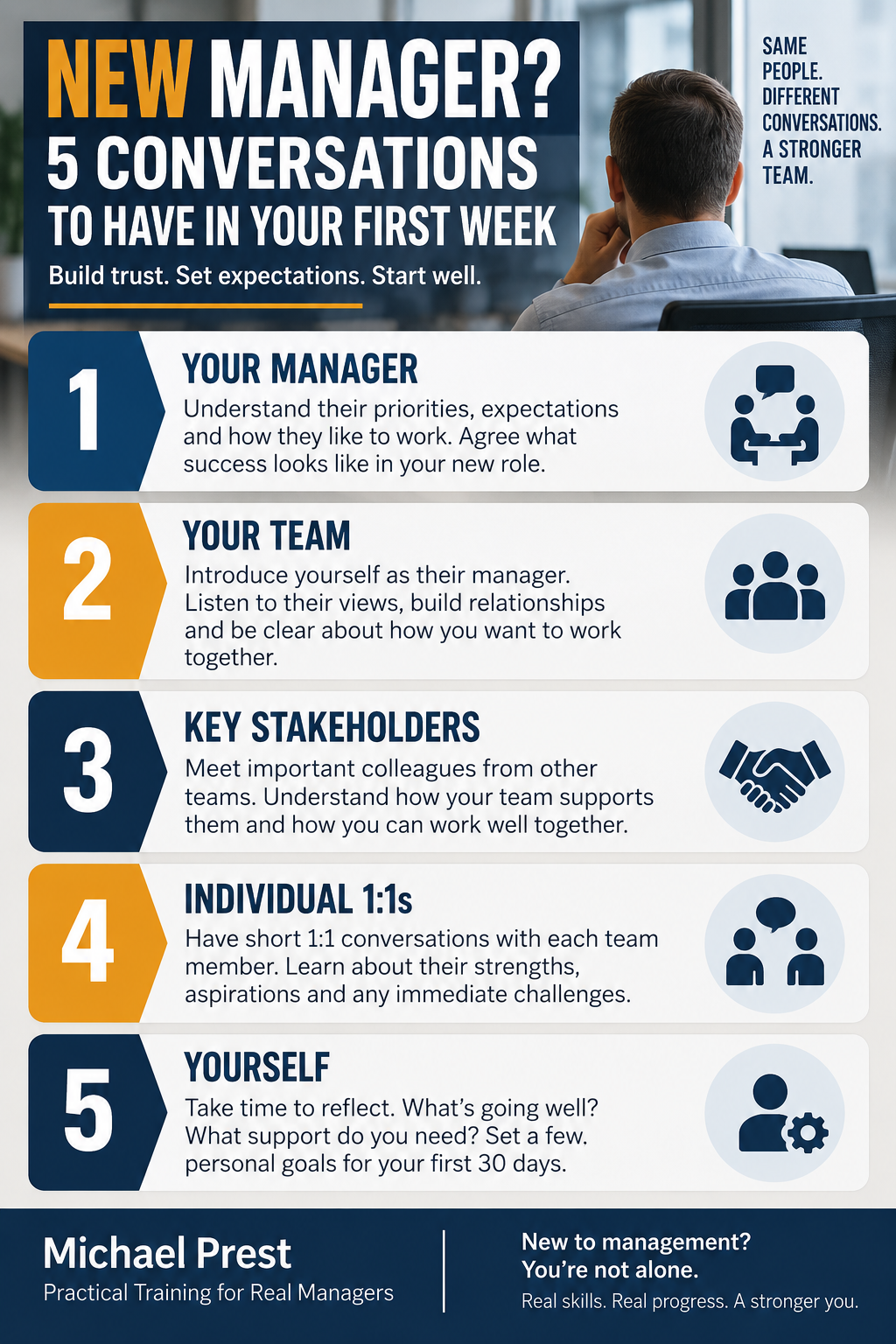
A practical first 7 days
- Day 1: clarify expectations with your manager and identify the immediate operational priorities.
- Days 1–2: introduce yourself clearly in the new role and listen to the team before announcing changes.
- Days 2–4: hold short individual conversations and learn what each person owns, where they are strong and where support is needed.
- Days 3–5: meet the people outside your team who depend on its work.
- By the end of week one: choose a small number of priorities and establish the routines you will use to track them.
Common first-week mistakes
Trying to demonstrate authority immediately, promising solutions before understanding the problem, continuing to do your old job, avoiding difficult conversations and changing routines simply to show that you are in charge can all create unnecessary friction. Early credibility usually comes from consistency and follow-through rather than dramatic change.
First-week checklist
- I know what my manager expects from me.
- I know the most important measures or outcomes my team owns.
- I have spoken individually with the people I manage.
- I know the key stakeholders outside the team.
- I have identified what genuinely needs immediate attention.
- I have a simple routine for priorities, conversations and performance review.
Want a broader first-30-days system?
First 30 brings the core early-management priorities together into one focused programme, including understanding the management role, owning the numbers and building practical habits for the first month.
Explore First 30